
Everything People
Ask Us
If the answer lives on a page of its own, we link to it rather than repeat it here. Anything still unanswered, just ask us.
Registration
4 questionsWhat does it cost?
Full Graveler is $1,100 and Half-Grav is $400. Early-bird pricing on both closed on June 1.
A non-rider place can be added to your registration for someone traveling with you who is not riding.
Is registration still open for the 2026 Graveler?
No — online registration for the 2026 Arkansas Graveler has closed.
If you already registered and have a question, contact us and a real person will get back to you.
Can I get a refund, defer, or transfer my entry?
Through August 31, you can cancel for a full refund minus a 15% administrative fee, processed in three to five business days.
From August 31 to September 8, you can transfer your entry to another rider in the same category at no charge, or defer to 2027. Deferral requests must reach info@arkansasgraveler.com in writing before September 8, and come with a code for 75% off next year's entry, with 25% repaid at registration.
After September 8, deferrals cannot be honored without proof of extenuating circumstances.
Can I still register for the 2026 Graveler?
Registration is handled by BikeReg. You will see the same prices there that you see here.
How fit do I need to be?
Fitter than a weekend ride, less than you think. The days run 34 to 99.5 miles with around 7,500 feet of climbing across the week, roughly a third of it on day one.
There is no clock and nobody is timing you. If you can ride 50 miles on gravel and get up and do it again the next day, you can do this week.
Is it a race?
No. There is no podium, no timing, and no categories. Fast riders are in by lunch and nobody minds either way.
Are there cutoff times?
This year, because of sunset times and some long mileage days, we will have to implement cutoff times so no one is riding in the dark.
If you think you may be at risk on the longer days, remember we have the "jump ahead" option for the final two days where you'll start at Aid Station #1 to make the day more manageable.
What if I can't finish a day?
Take the SAG vehicle to camp. It happens on every edition, nobody keeps a list, and plenty of people ride the whole of the next day.
Which is the hardest day?
Not day one, though that is the one people are thinking most about.
You start in Jonesboro on Crowley's Ridge, and getting off it accounts for about a third of the week's climbing. That number makes day one look like the hard one. It is not.
The last two days are. Back-to-back long ones, after three days already in your legs, with no hills to blame it on, just distance and whatever the wind is doing.
What you have going for you is that you come into those days off Helena and the King Biscuit Blues Festival. That glow carries further than you would expect.
Can I ride an e-bike?
Yes, and about a quarter of returning riders do. Bring a second battery or an extender, because some days will use a standard one up.
Each morning you bring your topped-off spare to the aid station truck, which carries it out to you so you can swap on route. There are charging stations at the venue every day.
Flat sounds easier than the Ozarks. Is it?
No. It is a different kind of hard.
In the mountains you earn a climb and then you coast, so recovery is built into the day whether you want it or not. Here there is no coasting. You pedal every minute you are on the bike.
Then there is the wind. Open country gives you nothing to hide behind, and on a levee road a headwind stays with you.
What is easier: when the wind swings around behind you, it carries you further than any descent. No mountain gearing. No chunky descents to handle. You can ride beside somebody all day in a way a climb never allows.
What is the surface like, and what tires should I run?
Mostly gravel, with pavement mixed in. These roads get fresh rock, because heavy farm equipment is hard on a road and new gravel goes down regularly. Fresh rock sits loose on top and moves under your wheel.
That is why tire choice matters more than bike choice here. A wider tire floats over loose material. A narrow one digs in and you fight the road all day.
Nothing under 38c. 42 to 55mm is the range, and we strongly recommend tubeless.
Tell me about the wind.
Wind is the thing that shapes a day out here. There is nothing to break it up. No hills, no tree line, no cut through a ridge. What the wind is doing at seven in the morning is largely what it will be doing at two in the afternoon.
Two things help. Ride with people, because a group splits the work in a way that matters more here than anywhere with hills. And check the forecast the night before, so it is a condition you plan around rather than something that happens to you.
What is the weather going to do?
October is a very good month down here. Many will tell you it is the best. Expect average highs in the upper 70s to low 80s and average overnight lows in the low to mid 50s, so pack for both ends of the day.
This is open farm country, so there is very little to ride under. Sun is on you for most of the day and that matters more than the temperature reading.
We ride in the rain. If lightning is near we shelter, and every host location has a designated indoor space for weather that turns serious.
It is harvest season. What does that mean out on the roads?
You are riding through the busiest month of the year for the people who live here. Combines are in the rice and soybean fields, grain trucks are moving loads, and equipment is on the road because that is where it has to be.
Our position is simple. We yield. When you come upon working equipment, you give way and let it do what it is doing. You do not squeeze past, you do not make a truck wait on you, and you do not assume a driver has seen you.
Expect dust behind equipment and fresh gravel where it has been working. Ride single file on pavement and bring a rear light.
These roads are open to us because the people who use them for work are willing to share them.
Are GPS route files available?
Yes. GPS files for all five days are out. Load them before you travel and check them offline, because cell service out here is patchy in places.
How likely am I to get lost?
Not very. The files are detailed and the route is marked. Load them before you travel so they work offline, because cell service out here is patchy in places.
Do not forget your GPS head unit and charging cables.
What happens if it rains hard the night before?
We ride. The pavement is unaffected. Unpaved sections change with the weather: fresh gravel firms up and rides better wet than dry, while sections with more soil get heavy, which is where you drop your pressure and take the day as it comes.
If a section of road becomes impassable, we adjust the day's riding accordingly.
What food is included?
Breakfast and dinner every day, plus aid stations on the road. The Graveler does the cooking, working with local suppliers and the food traditions of each town, so dinner changes as you move south.
There is also a wide variety of Honey Stinger products at breakfast to take with you for the road.
What is at the aid stations?
At least two fully stocked aid stations on every day, three or more on the longer days four and five, each with at least one porta-potty, plus a roving aid station to top you up anywhere on the course.
Hydration includes water, a full range of Coca-Cola products from Ozarks Coca-Cola, and electrolyte drinks. Nutrition comes from our partner Honey Stinger, alongside sweet and salty snacks. Aid Station 2 has a make-your-own sandwich station with a selection of meats and peanut butter from Teddie Peanut Butter.
Do I have to camp?
No. Camping is included and it is where the week actually happens, but there are non-camping accommodations available in neighboring towns if the host city does not have them.
Note that they may be many miles from the route, and your bag still travels to the camp venue, so plan how you will collect it.
Are showers available?
Yes. Showers are provided daily at the host venue at no additional cost. Where a campsite does not have enough showers, portable showers are brought in, so you always have a place to clean up after the ride and before the evening.
Will I have power for a CPAP machine overnight?
Generators do not run overnight in the general tent camping area, so the surest plan is a battery or battery pack sized for a full night's use. If you would rather plug in, generators do run overnight near the Pork Belly trailers, and we can place your tent close to them if you let us know ahead of time. Bring your own extension cord, since we do not supply them.
If your machine uses a humidifier, bring your own water for it. We provide water on course and at camp, but it is not distilled, and most CPAP humidifiers call for distilled water specifically.
Email us at info@arkansasgraveler.com before the event so we can plan your tent placement.
How do I charge my e-bike?
There are charging stations at camp every day where e-bike batteries and other electronics can be charged.
We still recommend bringing a battery pack for charging your electronics — phones, cycling computers, and the like — but the stations are there for anything that needs an outlet, including your batteries.
Where does my spare e-bike battery go during the day?
Each morning, drop your spare battery off at the trucks before you roll out — there is a dedicated container for them. It rides ahead with the aid station crew and will be waiting for you at the aid stations.
Please be sure to label your battery so it is easily identified.
I have a dietary requirement
Tell us when you register rather than on day one, and the kitchens can plan for it properly.
Can I bring an RV?
Yes. On-site dry-dock parking is $100 for the week, collected at registration, and does not include hookups. If you need hookups, arrange private accommodations along the route.
Your RV driver needs to register as a non-riding participant to join meals and evening activities.
Which airport should I fly into?
Memphis. MEM is about 80 miles from Jonesboro, a little over an hour by car, and it has the most flights and the most competitive fares of anything within reach of the start.
Little Rock works if the flights suit you better. It is about 130 miles and closer to two and a half hours.
Rent a car and drive up to Jonesboro. Parking there is free for the whole week.
Where do I park, and how do I get back to my car?
Free parking is available for the duration of the event at either end of the route, including the Helena / Storm Creek lot for Half-Graveler participants. Select the complimentary return transportation add-on during registration.
Complimentary charter buses run back to Jonesboro and Helena / Storm Creek on the morning of Sunday, October 11, with a truck carrying bikes to the same two places. Second bikes cannot be transported.
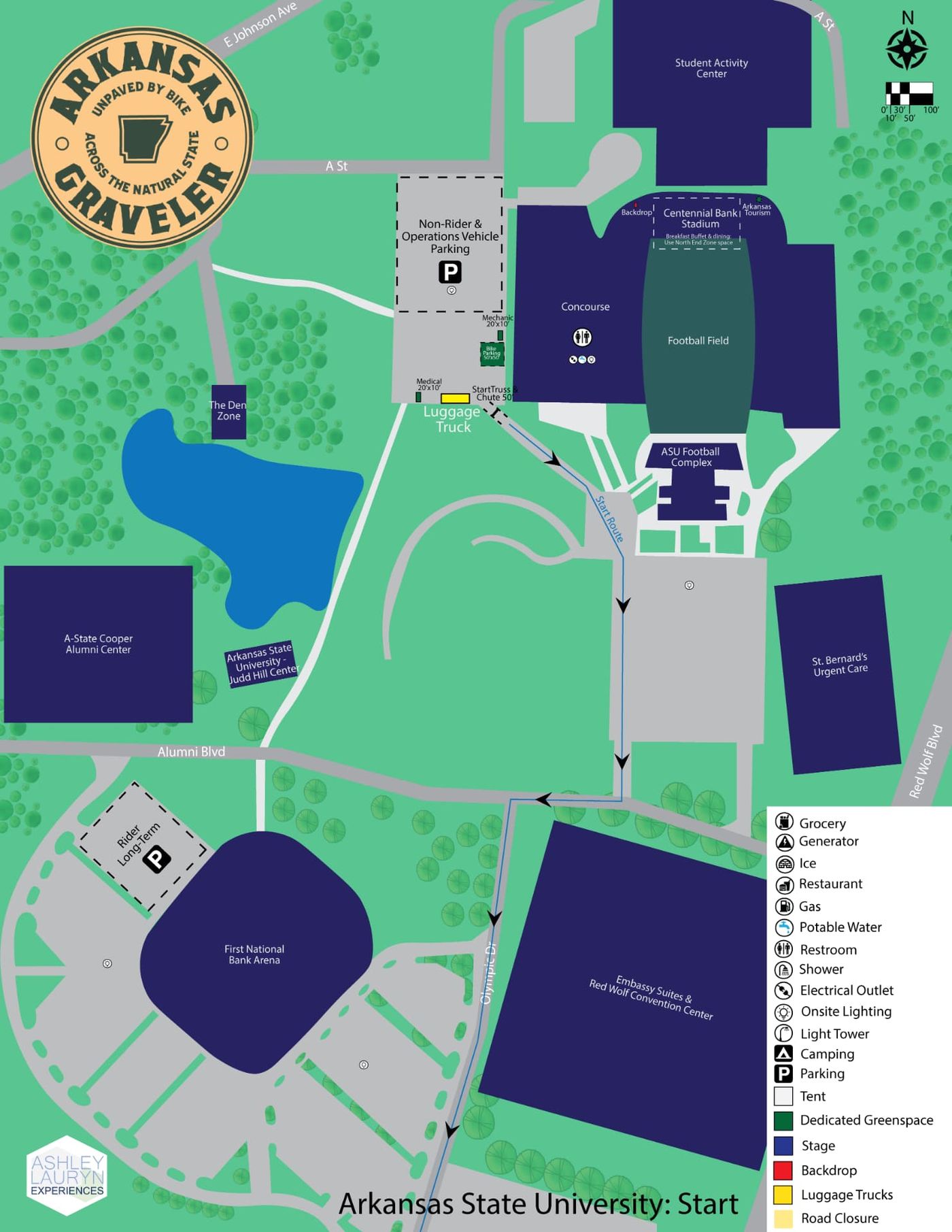
On Monday, ride the flat 3.8 miles from the lot to The Forum on Main Street for packet pickup and the opening party. Campus-to-Forum route →
Can my partner come if they don't ride?
Yes, and we are building them a route of their own.
Non-riders travel between venues under their own steam, so we are putting together a driving route for the week. It takes in much of what the riders will see, plus a few places they will not get to, since a car can reach things a bike route cannot.
The rest comes with it: meals, camp, nightly music, the King Biscuit Blues Festival, and outdoor recreation at the venues.
Can I bring children?
Children under 8 come free with a registered adult. Children 8 and older register the same as an adult and take part in everything.
Riding is restricted to ages 14 and older, and riders under 18 must ride with a registered adult guardian.
What happens to my bag during the day?
You drop it at the gear truck in the morning and it is waiting at the next camp, numbered against your rider number. Anything you need during the day goes on the bike.
Do we need to buy tickets to the King Biscuit Blues Festival?
No. A one-day Blues Festival admission is included in your registration. The route puts you in Helena on October 8 for the festival, which is the whole idea.
Ask. We would rather answer a question now than have you decide against a week you would have loved because nobody told you the SAG van exists.